
Robocop Versus Terminator Gameplay
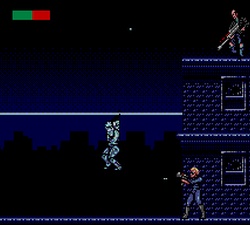
"RoboCop vs. The Terminator" doesn’t waste a second on warm‑ups: from the jump you’re already charging through gunfire, in lockstep with that steel‑toed march and the rattle of the Auto‑9. It’s one of those rare runs where you literally feel the power in your fingertips: every hop has heft, every burst gives a firm shove forward. No explanations needed—the rhythm grabs you. Lunge, half‑beat pause, two strides, a precise 45‑degree lean, and a thug tumbles off a catwalk in a red spray of pixels. RoboCop vs. Terminator is adrenaline on the nerve endings, the kind where you hold the trigger and listen as the stage turns into a battlefield—and you’re the law.
Rhythm of fire and motion
No waiting here. It’s run‑and‑gun in its purest form: shooting on the move, heel turns, split‑second calls. The base pistol is infinite, but power‑ups don’t last: snag a “machine gun,” “plasma,” or a rocket launcher and your style shifts on the fly. MG for hosing corridors; plasma for chewing through endoskeleton armor; rockets for anything that doesn’t take a hint. Most important of all—angles. In RoboCop vs. The Terminator you’re aiming diagonally, tagging high platforms, clipping turrets, hitting control panels to kill a laser grid and slip through before it powers back up. Your hands memorize the cadence: two of these, one of that, pause—jump—finish.
You’re always balancing swagger and caution. The hero’s tough, not immortal: in tight shafts one sloppy dash and a press pins you to the deck while an electric arc shaves half your bar. Die, and you’re bumped back near the start of a segment, already sensing where to push and where to breathe. There’s no timer squeezing you—the level’s rhythm does. It paces your breathing: ride the conveyor, hit a checkpoint, quick wind‑up, and you’re blasting into a fresh bay.
Detroit’s streets and factories
The opening Detroit beats are scrappy shootouts across scaffolds, billboards, and half‑abandoned blocks. Snipers up top, shotgun punks below, turrets on the sides. RoboCop vs. Terminator doesn’t coddle, but it’s honest with its hints: read deep into the screen, lead your shots, play the high ground. Construction sites make diagonal fire shine—lock the rhythm, drop two goons above, crack a medkit crate, snag an extra life as it falls—and hit the lift.
The first truly “ironclad” exam is ED‑209. A classic duel: the brute roars, sprays bursts, carpets the floor with rockets. The trick isn’t brute force—it’s patience. A boss fight here is a dance, not a dump: step left, pop the knee, dash under the volley, another burst. Give it a couple tries and you start hearing the song of the fight. It’s as rhythmic as the city around it.
Inside OCP: presses, lasers, shop floors
When RoboCop vs. The Terminator pulls you inside OCP, the space shifts. More verticality, more traps, more precision. Conveyors feed you into spikes, moving platforms force perfect landings, and electric grids snap on a timer. Then it clicks why the diagonal shot is so responsive: entire sections open if you pick off a top‑left panel in time or silence a turret locking the lane. It looks like “just a platformer with firefights,” but it’s really a string of reaction puzzles with bullets.
This is where the game teaches economy. Don’t waste plasma on small‑time hoods—save it for armored drones. Rockets belong in narrow rooms where splash rules. And if you burn through boosts, the baseline Auto‑9 won’t fail you: crisp cadence, tight recoil feedback, and suddenly you’re lord of the corridor again. Little secrets—thin walls, ledges hiding medkits, pockets with 1UPs—pop up often, and every tucked‑away nook you uncover feels like a personal win.
Leap into Skynet’s future
When you punch through to the future, the emotional palette flips. Steel, cold light, endless assembly lines—and T‑800s advancing not as a crowd but as a wall, without fear. The “platformer” pivots into high‑speed survival: saw blades, laser traps, floor presses, and hunter‑killer drones run you through the gauntlet. In this stretch RoboCop vs. Terminator is pure Skynet factory—everything either wants to crush you or punch holes in you. You learn to listen to the level: when a press hums, when a laser clicks, when it’s safe to dive into a lift shaft.
Mechanical “dogs” leap in packs, spider‑bots crawl the walls, and something is always erupting from the floor right behind you—literally. Diagonals and spacing save your hide. Step back, two shots, short hop to let a rocket scream past your head—now you’re dictating the tempo. Then come the tall shafts feeding you upward: ride a platform, pop a turret as it rotates, catch the next “elevator.” The finale is Skynet’s heart. Not just a “big boss”—a room‑trap where every whiff stings. Learn the pattern, catch the cadence of the barrages, and your last plasma volleys spear the glowing core.
Little rules for a big fight
RoboCop vs. The Terminator on Sega Genesis/Mega Drive rewards the attentive. Spot a suspicious nook—check it, shoot it, jump it. Notice enemies spawning from the same hatch—pre‑aim a grenade or hose it with the MG. Lives melt fast, but medkits are placed with intent: before a nasty sequence, after a meat‑grinder room where T‑800s rush you point‑blank. Passwords between blocks let you breathe, but don’t go soft: each stage asks for a hair more precision in jumps and fire. It’s not “controller‑smashing” hard—it’s fair reflex training, and that sweet rush when your fingers move on their own and the screen falls into your groove.
And yeah, call it “RoboCop vs. The Terminator,” “RoboCop vs. Terminator,” or just “the cyborg cop vs. the endoskeleton”—the core doesn’t change: a quintessential 16‑bit brawler where the tang of metal and ozone, the confetti of pixel sparks, and that confident, measured stride fuse into pure play. It feels like you jumped in for a minute and came to hours later, hands warm and a grin stuck on your face, because every duel, every laser, every conveyor wasn’t luck—you beat them to your own rhythm.